
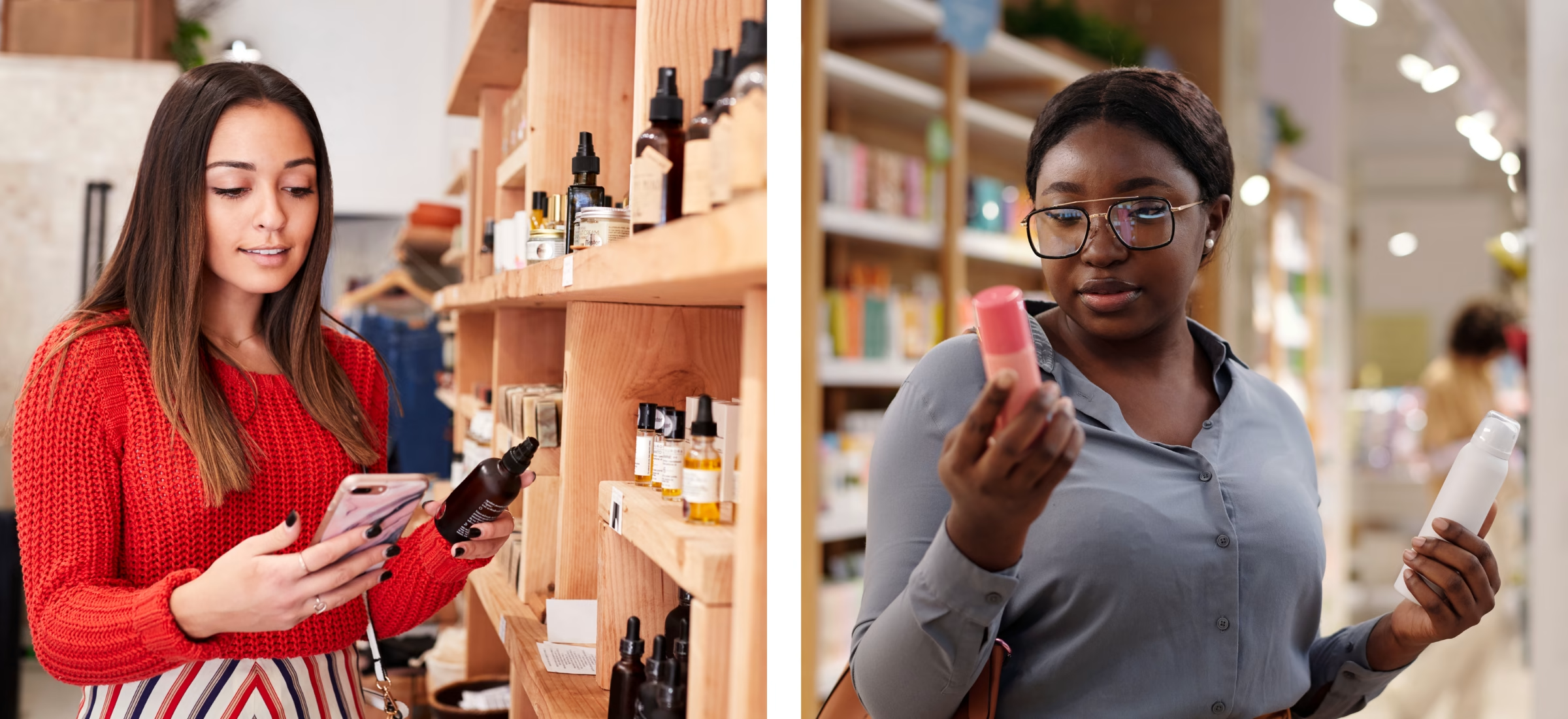
In the fast-growing natural beauty sector, consumers often ask: which are the best natural beauty products?
With beauty awards across the globe crowning various “Best of the Year” titles, such as “Best Shampoo”, “Best Natural Serum” and “Best Sunscreen” yearly, consumers are becoming increasingly confused.
As multiple products on the same store shelf claim to be the best, it is difficult to distinguish between the different claims.
The underlying, important question a consumer would like to ask is: What does the beauty award or the label in question really represent?
Is it a marketing headline, or is it a credible signal of quality?
Why ‘Best of the Year’ Awards Fail to Represent the Best Beauty Products
Across the industry, most awards follow the familiar format: one awarded product per category.
The formula appears straightforward. Competition produces a winner.
But this model oversimplifies reality.
A shampoo for curly hair, one for dry hair, and one for colour-treated hair are fundamentally different products designed for different needs. Declaring one as “the best” implies universal superiority — an assumption that ignores formulation constraints, consumer diversity, and product specialisation.
The same applies to skincare. A serum for acne-prone skin cannot be meaningfully compared with one designed for mature or hypersensitive skin. Each operates within its own functional and technical framework.
When a single product is crowned across a category:
- Context disappears
- User diversity is flattened
The result?
In a market already saturated with claims, additional superlatives do not create clarity. They create noise.
Excellence Is Contextual: A Useful Analogy
A helpful way to understand this is to look at gastronomy. The Michelin Guide does not declare a single “best restaurant in the world.” Instead, it recognises restaurants that meet clearly defined standards of excellence. Multiple establishments, across different cities and countries, can simultaneously achieve recognition.
A restaurant in Copenhagen does not invalidate one in Milan.
Different cuisines, contexts, and philosophies can all reach exceptional levels.
Excellence, in this system, is plural.
Natural beauty operates with similar complexity.
Therefore, why should only one product in the beauty sector be declared universally “the best”?
Excellence in beauty and wellness — like excellence in cuisine — can exist simultaneously in multiple places.
How THE ENBA Evolved to Set a Trusted Standard for Natural PRODUCTS
When the European Natural Beauty Awards (ENBA) were first launched, we adopted the conventional industry model: one awarded product per category, per year. It was easy to understand, as the model already existed.
But as jury evaluations progressed, a structural issue became evident.
In some categories, several products achieved almost equally high scores in efficiency and sensoriality. The differences were often marginal and sometimes subjective due to differences in the evaluators, such as their hair texture or skin condition. Ranking one above another increasingly felt arbitrary — and disconnected from the reality of the European market.
The market did not lack excellence.
It lacked a credible benchmark.
We recognised that consumers, and buyers alike, needed a trustworthy reference for naturalness and performance — not another marketing headline.
Especially in a market where authentic natural beauty and wellness products still represent less than 8% of total products, the priority is not selecting one product champion. It is making genuine quality visible.
This realisation led the ENBA to fundamentally evolve its methodology in 2023.
Instead of crowning a single winner, we introduced an excellence-based recognition system grounded in measurable standards.
Products are recognized when they achieve:
- Minimum score: 4.0 out of 5.0
- Evaluation criteria: Naturalness, efficiency, sensoriality
What DO These Criteria Mean?
- Naturalness criteria assess ingredient integrity and formulation transparency. Only products formulated with ingredients of at least 99% of natural origin and following the latest revision of leading natural standards are eligible, which excludes roughly 92% of beauty products on the European market.
- Efficiency criteria measure how well a product performs its intended function, after 3 months of evaluation by the star jury, representing the conscious consumers of today.
- Sensoriality criteria evaluate the quality of the user experience — such as texture, absorption, fragrance, and overall satisfaction.
The Excellence label is earned through multidimensional performance, not artificial hierarchy.
Excellence Begins with Selection
Evaluation at the ENBA does not start with scoring. It starts with eligibility.
Only products formulated with ingredients of at least 99% of natural origin qualify for evaluation. This criterion excludes approximately 92% of beauty products currently on the market before jury testing even begins.
This pre-selection ensures that every product entering the evaluation pool already demonstrates a serious commitment to natural formulation integrity.
From Marketing Claims to a True Benchmark in Natural Beauty
For the natural beauty sector to truly mature, it needs systems that elevate quality and authentic naturalness, and provide reliable guidance for consumers and professionals alike.
The products and brands recognised by the Excellence label prove that it is entirely possible to create effective, stable, and pleasurable products using natural ingredients. These products consistently combine performance, sensoriality, and formulation integrity — without relying on synthetic shortcuts.
This renders a common justification from laboratories — “we prioritise efficiency, so we need synthetic ingredients” — obsolete. Nature-based excellence proves that high-performance products and respect for human and environmental health can coexist, establishing that this level of quality can and should become the standard for the entire sector.
The Excellence Award represents a clear, defensible standard of quality in natural beauty. It provides a trustworthy benchmark, rewards genuine formulation rigour, and helps the sector raise its standards.
> Discover all the awarded products on the Natural Beauty Directory.
A Necessary Distinction: Product Excellence vs. Innovation Recognition
It’s important to clarify that the ENBA’s excellence-based approach applies specifically to product performance awards — those rooted in formulation quality, effectiveness, and sensory experience.
The ENBA also celebrate innovation and leadership through a distinct set of awards that serve a different purpose and are judged under a different logic. These include:
- Sustainability Pioneer of the Year — highlighting brands that embrace environmentally friendly practices throughout the entire lifecycle.
- Formula Innovation of the Year — recognising products that introduce new natural ingredients, properties, or formulation methods that elevate efficacy, stability or practicality.
- Packaging Innovation of the Year — honouring advancements in sustainable, functional, and creative packaging.
- New Brand of the Year — spotlighting emerging brands making meaningful early-stage impact in the natural sector.
- Media’s Choice Award, selected by leading beauty editors and journalists, celebrates products that resonate deeply with market relevance and consumer appeal of today.
In contrast to product excellence evaluation — which is category-specific, contextual, and plural — innovation awards are designed to recognise breakthrough thinking, strategic vision, sustainability leadership, and market impact.
They are not about ranking products based on consumer performance alone, but about highlighting those who push boundaries and meaningfully shape the future of the beauty industry.
In this context, awarding a singular title for a brand, product, or creative achievement is not superficial. Innovation is by nature comparative and directional — it identifies those who lead progress. After all, if everyone could innovate, it would not be innovation.
By applying distinct evaluation frameworks to product performance and to innovation leadership, ENBA ensures methodological integrity – signalling both credible quality for buyers and consumers as well as positive transformation across the sector.